Introduction: The Proliferation of the Modern Retreat
Coordinating a successful getaway for 20+ people requires more than just a calendar; it requires a proven Retreat Planning Playbook. In this comprehensive group travel guide, we break down the logistics of luxury stays in the Salt Lake Valley.
In the landscape of modern travel, a seismic shift has occurred. The era of fragmented family vacations and sterile hotel-based corporate seminars is rapidly closing. In its place, the concept of the “Retreat” has emerged—a purposeful gathering of large groups seeking synchronization, deep connection, and the shared engineering of lasting collective memories.
Whether it is a multi-generational family reunion attempting to bridge geographical divides, a corporate leadership team seeking tactical clarity away from the boardroom, or a niche group of athletes focusing on skill acquisition, the mandate is the same: A large group necessitates a specialized logistical architecture.
When a group expands beyond twelve individuals, standard travel infrastructure breaks. The logistical complexity increases exponentially, not linearly. Most large-group trips fail to achieve their social or professional objectives not because of the interpersonal dynamics of the group, but because the physical environment and the logistical “ground game” were never built to support them.
This masterclass article is a definitive playbook for the large-group trip planner, the corporate offsite coordinator, and the dedicated family organizer. We will dissect the granular logistics required to move, house, and feed groups of 20 to 60+ individuals. We will analyze the psychological importance of dedicated space, and we will introduce the single physical equalizer that is currently transforming the landscape of destination group travel: The specialized pickleball estate. To engineer memories that endure a lifetime, you must first master the science of large-group synchronization.
Part 1: The Architecture of Group Logistics
Destination Selection vs. Accommodation Strategy
The critical strategic error most large-group planners make occurs in the first phase of planning: prioritizing the generic “destination” (e.g., Zion, Moab, Park City) over the specific “accommodation strategy.”
If your group consists of 30 people, you do not have the luxury of casual spontaneity. For a large group, the “destination” is not the surrounding geography; the destination is the property you occupy.
If you are traveling to a world-class destination like Southern Utah’s “Mighty Five” national parks but are housing your group in fragmented hotel rooms or three separate residential houses fifteen miles apart, you have compromised the entire mission before arrival. You are spending 60% of your valuable retreat time managing transportation logistics, parking caravans of minivans, and coordinating text threads inquiring, “Where are you?”
For large groups (20+ guests), you must adopt a “Hub and Spoke” operational model.
- The Hub: This is your central basecamp—a high-capacity, dedicated complex that serves as the singular center of gravity for the entire group structure. It must be capable of providing absolute acoustic and social unification. Everyone wakes up, eats, socializes, and plays under a single, private control perimeter.
- The Spokes: These are the surrounding area excursions (the hiking in Zion, the skiing in Park City). The Hub must be strategically located to allow rapid access to these Spokes via continuous-flow transit arteries, bypassing high-congestion bottlenecks.
By securing the Hub first, you take control of 90% of your logistical friction points before you ever finalize an itinerary.
The Ground Game: Synchronized Transportation
Moving a large group from a major international airport (like SLC International) to your destination is the second significant operational hurdle.
For groups exceeding 15 passengers, standard “rental car logic” is an expensive and inefficient failure. A group of 40 people requires roughly 8 to 10 rental vehicles. Coordinating the pickup, fueling, and synchronized movement of a 10-car convoy through unfamiliar mountain terrain or high-traffic corridors is stressful and guarantees logistical separation.
The High-Capacity Driveway Mandate
If your group utilizes a private convoy strategy, your accommodation must possess industrial-grade staging infrastructure.
Standard vacation rental driveways are not reinforced for heavy vehicle volume and usually force tandem parking, which means cars block each other in constantly. This destroys group spontaneity. Large groups require sprawling, reinforced hardscapes that allow side-by-side parking for multiple 15-passenger vans and chaperone vehicles, allowing individual “sub-groups” (like the morning hikers versus the grocery runners) to move freely without conducting a 10-point turn or needing a valet.
The Professional Shuttle Strategy
For high-level corporate retreats or luxury destination travel, smart planners bypass rental cars entirely and engage professional, multi-passenger charter coaches for the airport “leg.”
While this seems like a premium expense, when you calculate the consolidated costs of 10 rental cars, premium fuel, and insurance—combined with the emotional ROI of a completely stress-free arrival—the charter shuttle strategy is often the more efficient allocation of funds.
Part 2: The End of the Hotel Block and the Rise of the Private Basecamp
When organizing a retreat for 30 to 60 individuals—whether for a high-stakes corporate strategy session or a massive family reunion before heading to Bryce Canyon or Park City—the default instinct is often to reserve a block of commercial hotel rooms. From a logistical standpoint, this is a critical structural error.
The Fragmentation of the Commercial Hotel
Commercial hotels are engineered for transient, individual travelers, not unified groups. When you place 40 people in a commercial hotel, you instantly fragment the organization.
- The Lobby Bottleneck: There is no private, communal living room. If a corporate team wants to debrief after a morning session, or if grandparents want to see their grandchildren in the morning, they must coordinate a meetup in a loud, public commercial lobby, sharing space with unrelated tourists and business travelers.
- The Acoustic and Security Nightmare: In a hotel, your group is dispersed across multiple floors and shared corridors. You cannot control the noise levels of adjacent guests, nor can you secure the environment. For corporate groups discussing sensitive intellectual property, or family groups managing young children, this lack of perimeter control induces constant underlying anxiety.
- The Loss of Spontaneous Connection: The true value of a retreat is not found in the scheduled itinerary; it is found in the “in-between” moments—the late-night kitchen conversations, the impromptu morning coffee on the deck. The hotel architecture actively destroys these moments by forcing individuals to retreat behind separate, locked doors.
The modern solution for large-group travel is the Acreage-Based Private Estate. By securing a massive, singular residential compound, planners establish absolute environmental control. The group remains unified under one roof, utilizing zonal layouts that offer private sleeping quarters but massive, exclusive communal gathering spaces.
Culinary Infrastructure: The Mathematics of Feeding 60 People
Food logistics represent the highest variable cost and the most significant source of operational friction in large-group travel.
If a planner attempts to feed a group of 40 to 60 people using the standard vacation model—eating out at commercial restaurants three times a day—the retreat will rapidly devolve into an administrative nightmare.
The Restaurant Friction Point
Do the fundamental mathematics: A moderate dinner out for 40 people, factoring in entrees, taxes, and mandatory large-group gratuities, can easily exceed $2,000 per sitting. Doing that every night drains tens of thousands of dollars from a corporate or family budget.
Beyond the staggering financial cost, the logistics are paralyzing. Finding a restaurant in a gateway town near Zion National Park or Moab that can accommodate a walk-in party of 40 is virtually impossible during peak season. Planners are forced into rigid reservations, followed by the nightmare of coordinating transportation for 40 people, waiting an hour for the kitchen to process the massive ticket, and dealing with complex dietary restrictions in a public setting.
The Performance Kitchen Strategy
To engineer a flawless retreat, planners must prioritize accommodations that feature high-capacity culinary infrastructure. The focal point of a successful group estate is the performance kitchen—specifically, designs featuring massive, oversized islands (often 10 to 12 feet in length) and dual appliances.
This architecture completely neutralizes the culinary friction point through two highly effective strategies:
- The Rolling Buffet and Bulk Provisioning: Instead of rigid restaurant schedules, the massive kitchen island serves as a 24/7 centralized fueling station. Planners can execute a single, highly efficient bulk-buy run at a premium warehouse club upon arrival. Breakfasts become slow, rolling affairs where guests grab coffee and food at their own pace. Lunches are frictionless, build-your-own sandwich stations.
- The “Anchor Dinner” Private Chef Hack: For the cost of taking 40 people to a mid-tier commercial restaurant, a planner can hire a local private chef to come to the estate. The chef utilizes the dual kitchens to prepare a massive, gourmet multi-course meal, serving the group at sprawling private dining tables. The group experiences a true luxury culinary event, drinks their own un-marked-up wine, and holds private speeches or toasts without shouting over restaurant noise.
The Pickleball Retreat Phenomenon: The Ultimate Demographic Equalizer
The most challenging aspect of planning a large-group retreat is the entertainment and engagement gap. How do you find a single activity that simultaneously engages a highly competitive 30-year-old sales executive, an energetic 12-year-old, and a 70-year-old company founder or grandparent without someone feeling left out, physically overwhelmed, or entirely bored?
Historically, corporate retreats leaned on golf, while family reunions leaned on hiking or extreme sports. Both of these fail the large-group test because they possess massive barriers to entry. Golf requires expensive equipment, high greens fees, and years of technical practice. Extreme mountain biking instantly excludes older demographics.
You need a physical “center of gravity” that effortlessly bridges the generational and athletic divide. Enter the Pickleball Retreat.
The Zero-Barrier Social Catalyst
Over the last five years, destination properties featuring private, professional-grade pickleball courts have become the most sought-after assets in group travel. From a group psychology standpoint, pickleball is the most effective bonding tool currently available.
- The Immediate Learning Curve: Anyone can pick up a paddle, learn the basic mechanics in five minutes, and be actively laughing and competing in ten. The court is smaller than tennis, the paddle is light, and the wiffle-style ball moves at a manageable pace.
- Low-Impact, High-Engagement: It is low-impact enough for senior executives or grandparents with joint concerns, yet fast-paced and strategic enough to keep highly athletic individuals fully engaged.
- Corporate Team Building ROI: For corporate offsites, a private pickleball tournament is the ultimate icebreaker. It flattens the corporate hierarchy. When the summer intern and the CEO are paired together in a doubles match, the traditional communication barriers dissolve instantly, fostering genuine, authentic workplace relationships that translate directly back to the office.
The Spectator Culture
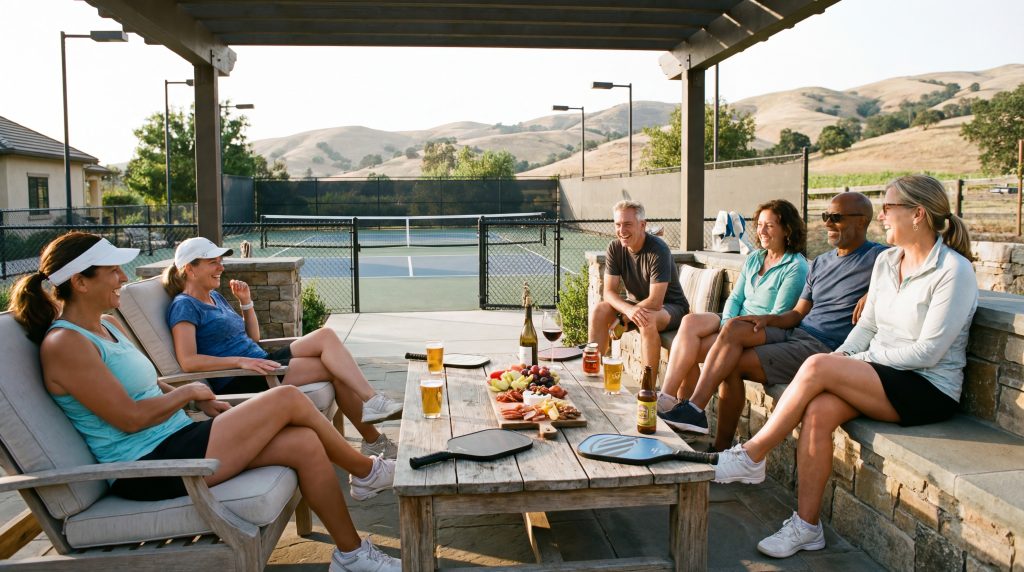
Crucially, a successful retreat activity must accommodate those who do not wish to play. The brilliance of a dedicated, private sports court is the spectator culture it creates. The less physically active members of the group can sit courtside, take photos, keep score, and actively participate in the banter. They remain a vital part of the action, rather than being left behind in a hotel room while the rest of the group goes on an excursion.
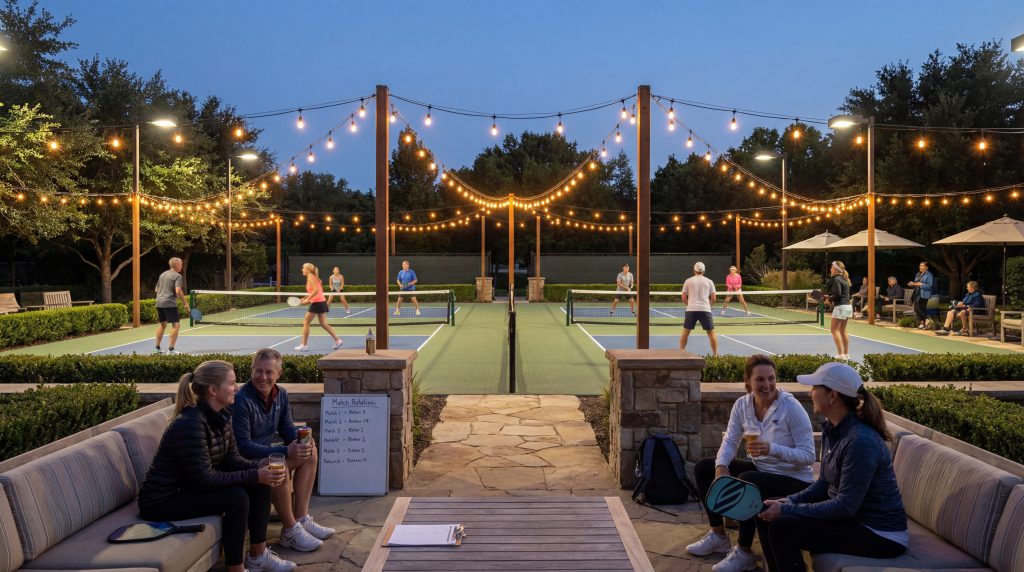
When you have lit courts just steps from your dining area, the agonizing daily question of “What are we going to do tonight?” vanishes. The entertainment is permanently installed, pre-paid, and universally inclusive.
Why a Retreat Planning Playbook is Essential for Groups
When you use a structured Retreat Planning Playbook, you eliminate the guesswork. A solid group travel guide should prioritize three things:
- Centralized Lodging: Keeping everyone at one luxury estate.
- Built-in Amenities: Ensuring the “Retreat Planning Playbook” includes on-site sports like pickleball.
- Seamless Communication: Using a digital guide to keep all guests on the same page.
Part 3: The Logistics of Rest, Recovery, and Environmental Decompression
When planners architect a massive corporate offsite or a 50-person family reunion, they often make the mistake of over-indexing on the itinerary. They pack the schedule with back-to-back trust-building exercises, intensive strategy sessions, or aggressive outdoor excursions to destinations like Zion or Park City.
What they fundamentally ignore is the physiological and psychological toll of high-density group dynamics.
When you place a large number of human beings together for an extended period, you generate a massive amount of sensory input. Extroverts thrive on this, but introverts are rapidly drained by it. Furthermore, when the group returns from a grueling 8-hour hike through Bryce Canyon or an intense, all-day quarterly financial review, they do not just need a place to sleep—they require a specialized environment designed for rapid physical and mental recovery.
The Failure of Passive Hotel Recovery
If your group’s hub is a commercial hotel or resort, recovery is functionally impossible. Passive recovery—simply retreating to a crowded hotel room and staring at a screen—allows physical stiffness to set in and does nothing to alleviate mental fatigue.
Attempting active recovery in commercial spaces is equally disastrous. Hotel hot tubs are notoriously undersized (often capping at four to six people), heavily chlorinated, and shared with unpredictable tourists. A corporate team cannot comfortably debrief a strategy session while sitting shoulder-to-shoulder with strangers, just as a family cannot relax when they are constantly worried about their children bothering other paying guests.
High-Capacity Hydrotherapy and Acreage Decompression
The modern retreat masterclass dictates that the accommodation must serve as a private wellness compound.
When a group secures a sprawling, acreage-based estate, the recovery protocols shift entirely. Premium group estates feature high-capacity hydrotherapy—massive, 15-to-20-person swim spas or oversized jacuzzis. This allows entire executive boards or starting athletic lineups to enter the water simultaneously. The hydrostatic pressure and heat increase blood flow, flush lactic acid from a day of skiing or hiking, and facilitate deep, private conversations under the night sky, far removed from the chaotic energy of a public resort.
Furthermore, private acreage provides the ultimate luxury for large groups: Sensory Decompression. After navigating the dense, overwhelming crowds of a major National Park, the ability to return to a private, gated compound is a psychological lifeline. Members of the group who are socially exhausted can take a quiet walk through a private orchard, read a book on an expansive mountain-view deck, or simply sit in silence without retreating behind a locked bedroom door. They remain present with the group while actively repairing their social battery.
The Mountain West Advantage: Establishing the Ultimate Utah Hub
As the concept of the private, large-group retreat has matured, travel planners globally have begun shifting their focus away from traditional coastal or tropical destinations. The logistics of organizing flights, managing hurricane seasons, and dealing with extreme humidity make tropical group travel a highly volatile investment.
Instead, the Mountain West—and specifically the state of Utah—has emerged as the premier global destination for high-capacity group travel. It offers a rare combination of world-class infrastructure, unparalleled safety, and immediate access to iconic geography.
However, the secret to mastering Utah travel is understanding where to place your Hub.
The Gateway Town Trap
A common logistical error is attempting to house a massive group of 40 to 60 people directly inside or immediately adjacent to the major “Spokes” (the National Parks like Zion, Bryce Canyon, or Arches in Moab).
While staying in a “gateway town” near a park entrance sounds romantic, it is an operational nightmare for a massive group. These small towns lack the bulk culinary infrastructure (like massive Costco warehouses) required to feed 50 people affordably. They are heavily congested with international tourist traffic, and their lodging options are typically restricted to small, fragmented cabins or overpriced, outdated motels.
The Salt Lake Valley Basecamp Strategy
The most sophisticated global travel planners utilize the greater Salt Lake Valley corridor as their central, luxurious Hub, treating the major parks as strategic day-trip Spokes.
Here is why this operational model is superior:
- Aviation and Arrival Logistics: Salt Lake City International Airport (SLC) recently underwent a multi-billion-dollar rebuild. It is one of the most efficient, weather-resilient transit hubs in North America. A large group can fly in from across the US and Canada, secure their charter shuttles or rental convoys, and be at a massive, private south-valley estate in under 40 minutes, completely bypassing downtown gridlock.
- Access to Bulk Infrastructure: By anchoring in the valley, the designated retreat planners have immediate access to premium grocers, bulk warehouse clubs, and private chef networks, allowing them to utilize their 12-foot kitchen islands to feed the group flawlessly.
- The “Spoke” Deployment: From a secure, private estate in the valley, the group has ultimate optionality. They can deploy an early morning convoy to Park City for world-class skiing (under an hour away), head south to the red rocks of Moab or Zion for a designated weekend excursion, or simply stay on the property to host a massive, multi-day pickleball tournament. The estate acts as an impregnable fortress of luxury that the group launches from and returns to.
Engineering the Unforgettable: The Psychology of Collective Memory
Ultimately, whether you are spending corporate capital to align a leadership team, or pooling personal funds to bring four generations of a family together, the true Return on Investment (ROI) of a retreat is measured in the durability of the memories created.
The human brain does not easily index or remember highly scheduled, structured events. We rarely remember the specific PowerPoint slides of a corporate seminar, just as we rarely remember the exact logistics of standing in line for a shuttle bus at a National Park.
Memories are forged in the unscripted, highly emotional “in-between” spaces. They are engineered when the physical environment strips away the friction of daily life and allows genuine human connection to take over.
The Acoustic Privacy of the Fire Pit
This is why the architectural layout of a private estate is so critical to the success of a retreat. When you remove the anxiety of commercial travel—when no one is worried about parking tickets, hotel noise complaints, or splitting a massive restaurant bill—the group collectively exhales.
The pinnacle of this experience often occurs late at night, long after the pickleball paddles have been set down and the dinner plates have been cleared. It happens around a massive, private outdoor fire pit.
When a group has absolute acoustic privacy—shielded from city noise and light pollution—a profound psychological shift occurs. The crackle of the fire and the safety of the private perimeter encourage storytelling, vulnerability, and generational bonding. This is where the CEO shares the authentic origin story of the company with the new hires. This is where grandparents pass down family history to teenagers who are finally disconnected from their screens.
These are the moments that define a group’s shared history. They cannot be scheduled, and they cannot be forced. They can only be facilitated by providing the right environment.
The Final Mandate for the Trip Planner
If you are the designated architect of your group’s next major gathering, you possess a massive responsibility. Do not squander your budget and your group’s limited time by forcing them into the fragmented, high-friction model of traditional hotel travel.
Recognize that your group is a distinct, living entity that requires a dedicated center of gravity.
Prioritize the physical architecture of your accommodation. Demand high-capacity culinary infrastructure to protect your budget. Seek out the ultimate demographic equalizer of private sports courts to unify your ages and athletic abilities. Secure a private, acreage-based basecamp that allows your group to retreat from the world, decompress in absolute safety, and focus entirely on each other.
When you master the logistics of the ground game, you stop managing a trip, and you begin engineering a legacy.
Explore The Playbook
We don’t deal in generic tourist advice. The articles below are deep-dive, masterclass guides written from the perspective of local experts who handle complex group logistics every single day.
Whether you are preparing for a massive global sporting event, organizing a multi-generational family reunion, or looking to radically overhaul your company’s Q3 strategy session, select your pathway below to learn exactly how it’s done.
(Note for your web design: This is where you insert the grid or sidebars linking to your massive articles)
👉 [Corporate Offsites & Team Building] The death of the boardroom retreat. Discover why elite tech companies and national brands are abandoning standard hotels for private pickleball tournaments and experiential offsites. [Read the Corporate Guide]
👉 [The 2026 World Cup Logistical Blueprint] Utah isn’t hosting matches, but it is hosting the world’s elite teams and their global sponsors. Learn the unvarnished reality of navigating the Salt Lake Valley during a global mega-event, and why the south valley is the ultimate basecamp. [Read the World Cup Reality Check]
👉 [Where to Stay Near Herriman: The Basecamp Guide] Stop looking at downtown hotel proximity maps. A deep dive into the specific geographic and logistical advantages of anchoring your massive group in the Bluffdale/Herriman corridor. [Read the Accommodation Guide]
👉 [The Utah Family Reunion Blueprint] Planning a massive multi-generational trip? Learn why booking hotel blocks actively destroys family dynamics, and how our acreage-based estates provide the perfect private center of gravity. [Read the Family Reunion Guide]
👉 [The VisitUtah.com Official Travel Guide Family Reunion Blueprint] “The Utah Travel Guide is filled with information for those who want to visit The Mighty 5® national parks, ski resorts, the urban Wasatch Front, and all the scenic drives and towns in between. [Download The Utah Travel Guide]